Is It Safe to Leave a Slow Cooker on Overnight?

Yes, if your slow cooker is in good condition, sits on a heat-safe surface, and the recipe runs for the full cook time, leaving it on overnight is usually safe. A bad setup can burn food, dry out dinner, or raise fire risk if the cord, outlet, or lid is faulty. This guide gives a fast safety checklist that separates appliance risk, food-safety risk, and recipe fit so you can decide in under two minutes.
Usually, yes. A modern slow cooker is built for long countertop cooking, and many are low wattage appliances that draw relatively little power while running. The key question is not whether it can stay on, but whether your unit, placement, and recipe fit an unattended overnight cook.
Use this rule: if the cooker is intact, stable, and set up for the recipe length, overnight cooking is reasonable. If the unit is old, borrowed, damaged, crowded in a tight spot, or being asked to hold food for an especially long time, pause and check before going to bed.
Slow cooker overnight safety checklist
Use this table as a quick go/no-go screen before bed. It separates appliance condition, placement, recipe fit, and morning handling so you can spot the real risks quickly.
| Safe to run | Pause and check first | Do not leave on overnight |
|---|---|---|
| Modern slow cooker in good condition | Older, borrowed, or vintage unit with unknown history | Frayed cord, cracked plug, loose outlet connection |
| Flat, heat-resistant surface with clear space around it | Placed near a wall, curtain, pet bed, or child reach zone | Unstable counter edge, tilted base, or wobbly surface |
| Recipe fits the full cook time on Low | Recipe may finish early or needs close attention | Warm mode expected all night for a full cook |
| Lid sits flat during cooking | Loose lid fit, cracked lid, or transport clamp only | Using clamps or straps to hold the lid while cooking |
| Enough liquid and ingredients below the fill line | Pot looks crowded or near overfull | More than two-thirds full |
| Food will be checked with a thermometer in the morning | Recipe has no clear finish point or protein target | No plan to check temperature or refrigerate leftovers promptly |
What the settings mean overnight
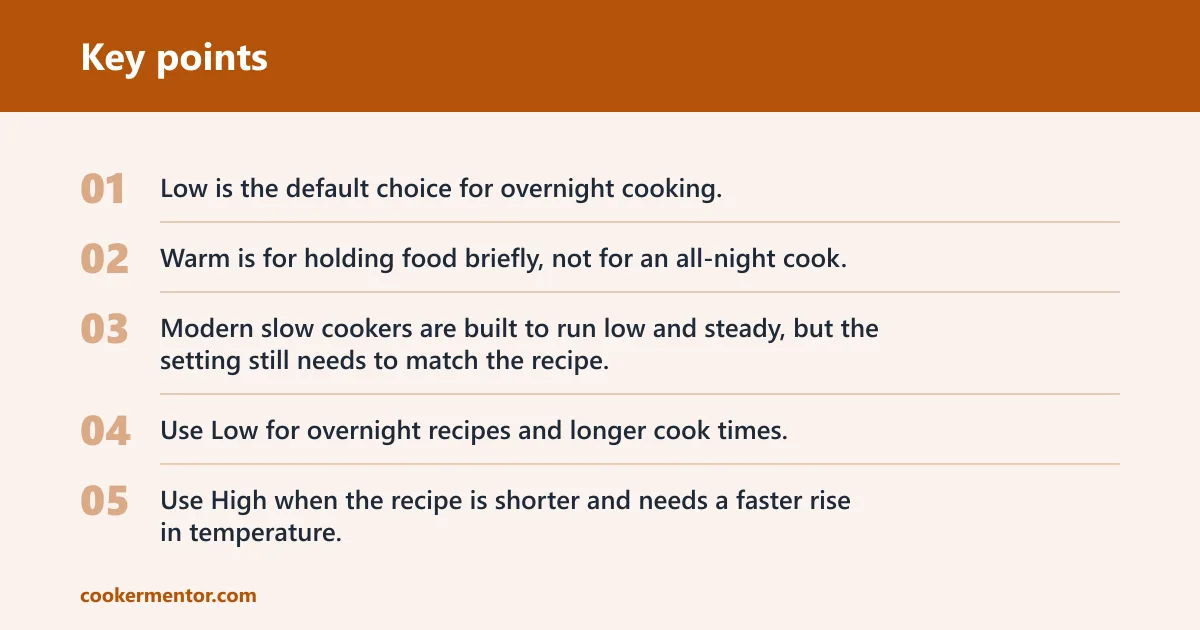
Low is the default choice for overnight cooking. It fits longer cook times, and one common reference point is around eight hours. High is better for shorter cook times, often around four hours, and it can drive off liquid too quickly if left too long. Warm is for holding food briefly, not for an all-night cook.
Modern slow cookers are built to run low and steady, but the setting still needs to match the recipe. A pot roast, chili, or soup may fit an overnight Low cook better than a lean cut or a dish with little liquid, which can dry out or overcook on High.
Low setting
Use Low for overnight recipes and longer cook times. It helps keep food moving through the heating range and is the safest fit for most overnight meals when the recipe is written for that timing.
High setting
Use High when the recipe is shorter and needs a faster rise in temperature. It is generally better for shorter cook times, and leaving it on High overnight can evaporate liquids too quickly or leave the food overdone by morning.
Warm setting
Warm is for short holding only. Good Housekeeping advises not to use Warm for extended periods and suggests keeping food on Warm for two hours or less. It is not the right setting for an all-night cook.
What should I check on my slow cooker before using it overnight?
Check the cord, plug, base, lid, and placement before you start. The cooker should be stable, the power cord should not be frayed, and the lid should sit normally without clamps. If the unit looks worn, borrowed, or vintage with unknown history, treat it as a pause-and-check situation.
Older or defective models raise risk because age and wear can affect the cord, heating element, switch, or internal controls. A unit that seems fine at lunch can still fail overnight if the plug is loose or the base is unstable. Do not assume that age alone is the problem; condition matters more.
Appliance condition checks
- Inspect the power cord for fraying, cracking, or damaged insulation.
- Check that the plug fits firmly in the outlet.
- Look for cracks in the housing, lid, or insert.
- Make sure the cooker sits level and does not rock.
- Confirm that any auto-off feature is known and predictable.
Placement checks
Set the cooker on a flat, heat-resistant surface with a common rule of thumb of at least a few inches of open space on all sides, away from walls and flammable items. Keep it clear of curtains, dish towels, paper goods, pet beds, and children’s reach. A slow cooker gives off less heat than many kitchen appliances, but it still needs open space around it.
Suppose a 6-quart cooker sits beside a hanging curtain and a stack of paper napkins. That setup should be moved before cooking starts, even if the counter itself is heat-safe. The issue is the clearance around the unit, not only the countertop.
Recipe fit checks
Use enough liquid and keep the pot below the fill line so food heats evenly. Taste of Home says a slow cooker should never be more than two-thirds full. If the pot is stuffed to the top, the food may heat unevenly, spill, or stay in the temperature danger zone for too long.
Slow cookers heat food to between 165 and 200°F. That range is useful only if the recipe is built for it. Dense casseroles, very large cuts, or very small liquid volumes may not heat through as predictably as soups, stews, or braises.
How to keep food safe in a slow cooker overnight
Food safety depends on whether the contents stay out of the temperature danger zone, which Good Housekeeping defines as 40°F to 140°F. For overnight recipes, the goal is to move food through that range promptly and keep it there only as long as the recipe allows. A food thermometer is the fastest way to confirm that the center of the food is safe in the morning.
Power outages, mistimed auto-off features, and uneven heating are the main failure modes to watch. If the power cuts out during the night, or the cooker shuts off earlier than expected, food may slip back into the danger zone. If the recipe is too full or too dry, some parts may cook faster than others.
Use a food thermometer
Check the thickest part of the food in the morning. For overnight recipes with meat, poultry, or mixed dishes, do not rely on appearance alone. A food thermometer gives the clearest answer when the center looks pale, the sauce still seems thin, or the meat is not falling apart yet.
Morning cooling and refrigerating workflow
Turn the cooker off. Switch it off as soon as cooking is complete. If the food will not be served right away, move directly to cooling steps instead of leaving it on Warm for hours.
Portion the leftovers. Transfer food to shallow containers so it cools faster. Good Housekeeping recommends refrigerating within two hours if you are not eating right away.
Refrigerate promptly. Get the food into the refrigerator within two hours of finishing. Keep the containers uncovered until steam drops, then cover and chill. This limits time in the danger zone.
Discard anything questionable. If the food sat too long after power loss, smells off, or spent an unclear amount of time below safe temperature, do not guess. When in doubt, throw it out.
Can I leave the house while my slow cooker is on overnight?
Usually, yes, if the cooker is in good condition, the recipe is suitable, and the setup is safe. Place it on a heatproof surface away from walls, keep the cord in good shape, and do not clamp the lid during cooking. If any of those conditions are uncertain, stay close or delay the cook.
Leaving the house is more reasonable with a modern unit, a known recipe, and a stable counter than with a borrowed or aging cooker. Homes with pets or small children need extra clearance, because cords can be pulled and hot surfaces can be reached more easily.
What to do if your slow cooker stops or smells odd
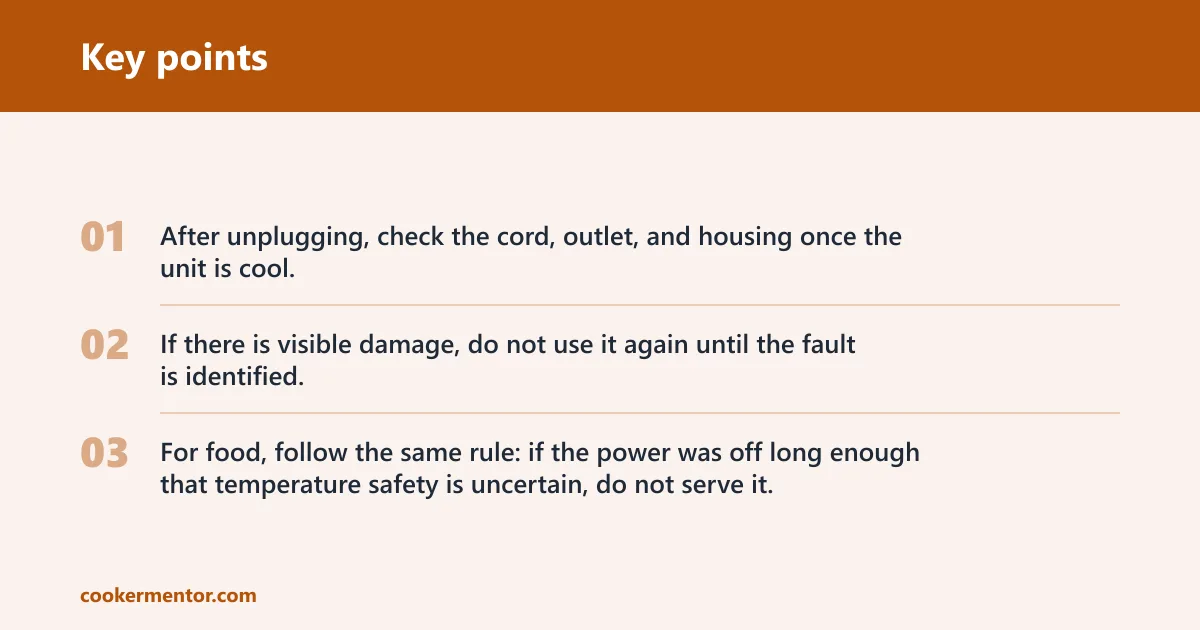
If it stops, trips a breaker, smells like burning plastic, or heats unevenly, unplug it right away if you can do so safely. Do not keep it running to “see what happens.” A strange smell can mean wiring trouble, a damaged cord, or overheated residue under the base.
After unplugging, check the cord, outlet, and housing once the unit is cool. If there is visible damage, do not use it again until the fault is identified. For food, follow the same rule: if the power was off long enough that temperature safety is uncertain, do not serve it.
Frequently asked questions
Is it safe to leave a slow cooker on overnight?
Yes, for many modern units and recipes. The cooker should be in good condition, on a stable heat-resistant surface, with a full cook time planned on Low. If the cord is damaged, the placement is poor, or the recipe needs close timing, pause and check first.
How long can a slow cooker stay on low safely?
Low is the right setting for longer cooking times, and one common overnight reference is around eight hours. Exact timing depends on the recipe, the amount of food, and the model. If the dish is still not done by morning, check temperature and texture rather than extending it blindly.
What slow cooker setting is best for overnight cooking?
Low is the best fit for overnight cooking in most cases. High is generally for shorter cooks, around four hours, and Warm is only for brief holding. If the recipe calls for a very long cook, Low is the setting that usually matches it best.
How do I keep food safe in a slow cooker overnight?
Keep the food out of the temperature danger zone as much as possible by using the right setting, enough liquid, and a recipe built for slow cooking. Check the center with a food thermometer in the morning, then refrigerate leftovers within two hours if you are not serving them right away.
Should I use warm mode overnight in a slow cooker?
No, not for an all-night cook. Warm is for short holding only, and one common recommendation is two hours or less. If the recipe needs overnight cooking, use Low instead. Warm does not provide the same margin for safe, even cooking over many hours.