Why Does My Slow Cooker Boil on Low?
A slow cooker that boils hard on low is usually running too hot, or it is set up poorly. If the contents reach a rolling boil, the unit may be out of spec. Left unchecked, it can overcook food, dry out meat, and make soups split. This guide shows how to tell normal simmering from a problem and what to fix first.
When bubbling on low is still normal
Low can still create steady bubbling, and in some models it can get close to a boil over time. The problem starts when the pot moves past gentle simmering into a rolling boil, where the surface churns across the whole liquid, steam rises strongly, and food starts moving violently around the insert.
Water boils at 212°F at sea level, which gives you a clear reference point. A slow cooker on low does not need to stay far below that number to cook food, so some bubbling is normal. What is not normal is a hard, sustained boil that keeps splashing, foaming, or forcing liquid toward the lid.
What normal bubbling looks like
Gentle bubbling usually stays near the edges or appears in small pockets under the lid. A light shimmer, a few rising bubbles, and occasional movement in the liquid can be part of normal low-setting behavior. That is very different from a pot that is actively churning.
A true rolling boil has broad, fast surface movement. The whole top breaks at once. Liquid turns over repeatedly, not just in one spot. If the lid rattles, the contents surge, or sauce climbs the sides, the cooker is running hotter than a simple simmer.
Why low can still get hot enough to simmer
The low setting is a lower-temperature, longer-duration mode, but it can still bring food to a simmer over time. High and low are usually timing differences, not exact burner temperatures. In many models, both settings can end up at roughly the same final cooking temperature, with high just getting there sooner.
That is why some slow cookers can take at least 3 to 4 hours even on high, while others move faster. Heat output, vessel size, and lid seal all affect the path to target temperature.
Slow cooker temperature basics
Low is meant for longer cooking, often about 6 to 8+ hours, and it may still reach a simmer or near-boil in some models. High reaches cooking temperature faster than low, but it can still finish near the same final temperature. Warm is for holding cooked food, not cooking raw food to safety.
Low, high, and warm
Think of low and high as time-to-temperature settings. High gets food hot sooner. Low does it more slowly. Warm should only be used after cooking is complete. It is not suitable for heating food safely from raw, especially if the food spends too long in the danger zone.
The temperature danger zone is 40°F to 140°F. Raw ingredients should not sit in that range for long during a slow warm-up. Frozen chicken, for example, should not be started in a slow cooker according to USDA-linked guidance cited in this article.
Fill level and boil behavior
Fill level matters more than many cooks expect. A common target is about 1/2 to 2/3 full. Overfilling can increase boil-over risk. Underfilling can make the edges run hotter, speed up heating, and create uneven cooking because the element and crock have less mass to buffer heat.
Capacity matters too. A 4-quart and a 7-quart unit can behave differently in water tests, even with the same setting, because size changes how much liquid sits over the heating surface and how quickly evaporation builds. Larger units may reach boiling sooner or differently depending on wattage.
What causes a slow cooker to run hot?
Most hot-running slow cookers are not “broken” in a single obvious way. Fixed-wattage heating elements, pot size, fill level, lid fit, and model design all affect heat output. Two units on the same setting can behave differently because slow cookers do not actively regulate maximum temperature like an oven.
Model wattage and fixed heating elements
Slow cookers use fixed-wattage heating elements. That means wattage differences help explain why one model runs hotter than another. A newer or more powerful unit may reach a simmer faster, and a compact unit can behave differently from a large one even when the controls look the same.
Age can matter, too. A lid that no longer seals well, a warped insert, or wear around the base can change how steam escapes and how heat stays trapped. Less steam loss can mean a hotter pot and more boil-over risk.
Batch size and lid fit
Batch size changes the heat balance. Too little liquid can heat faster at the edges. Too much liquid can rise higher and spill. If the lid sits crooked, heat and steam escape unevenly, which can change cooking speed and make the surface look more active than it should.
Say your 6-quart cooker is only half full of soup on low, and the center starts bubbling hard after two hours. The likely issue is not “all slow cookers boil.” It is a mix of lower fill level, a strong heating element, and a batch that heats quickly.
Slow cooker boiling matrix
Use this matrix to match what you see with a likely cause and a next step. The water-test temperature is especially useful because it separates a unit that is simply active from one that is running far hotter than expected.
| Bubbling level | Fill percentage | Cooker size | Water-test temperature | Likely cause | Recommended action |
|---|---|---|---|---|---|
| Gentle edge bubbles, no lid rattle | About 1/2 to 2/3 full | 4-quart or 7-quart | About 190°F to 200°F | Normal low-setting simmering | Continue cooking; check food earlier than the recipe suggests if the dish is delicate |
| Active simmer across part of the surface | Near 2/3 full | Often either size | About 200°F | Fast-heating model or tight lid | Shorten cook time, reduce batch size next time, or switch to low for less time before using warm |
| Fast bubbling with strong steam, but not a full churn | Above 2/3 full | Usually larger models | Near 212°F | Too much liquid and heat trapped under the lid | Reduce fill level to about 1/2 to 2/3 full and leave more headspace |
| Whole surface churns, splashes, or climbs the sides | Any fill above 1/2 | 4-quart or 7-quart | 212°F or boil-over | Unit runs hotter than expected or lid fit is poor | Test with water, compare to the table below, and replace the unit if it repeatedly overshoots |
| Edge scorching with little top movement | Below 1/2 full | Any size | Often above 200°F at the walls | Underfilling or uneven heat spread | Add a proper batch size, use more liquid, or choose a smaller insert for the recipe |
That matrix is meant for diagnosis, not guesswork. A cooker that hits 200°F in a water test is acting differently from one that reaches 212°F or spills over. Those three results point to different next steps.
A water test lets you check actual performance instead of guessing from a recipe. Use a digital thermometer and a measured amount of water. One cited test used 6 cups of water in both a 7-quart and a 4-quart slow cooker. The 7-quart boiled in a little under 2 hours on high, while the 4-quart took about 3 hours to reach boiling point.
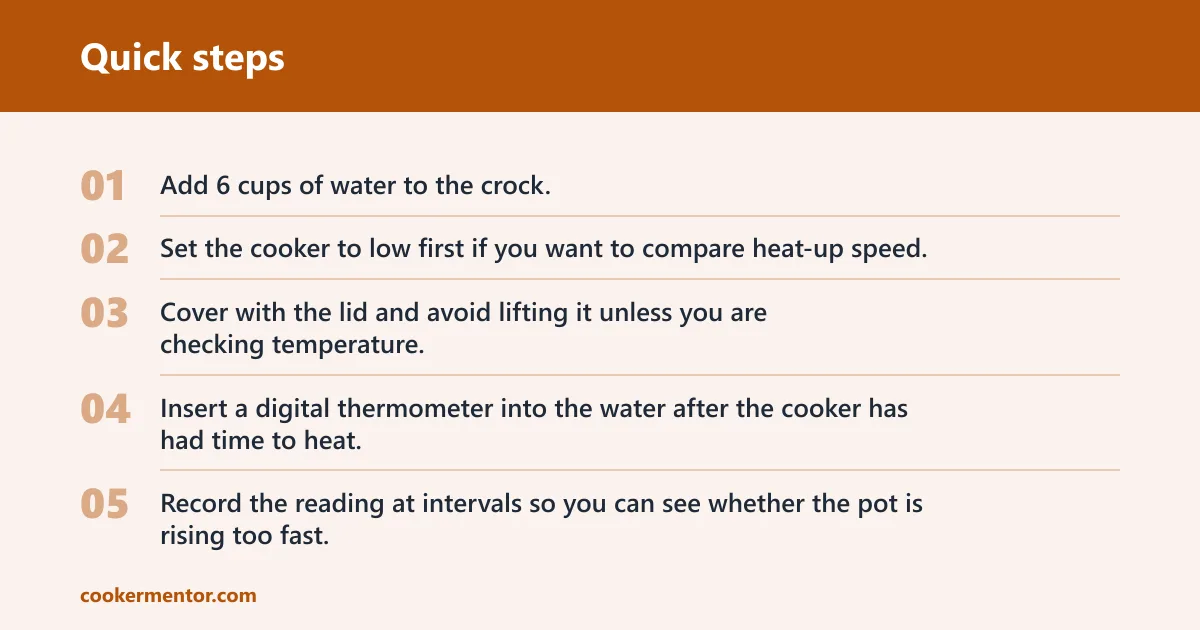
Set up the test
- Add 6 cups of water to the crock.
- Set the cooker to low first if you want to compare heat-up speed, then repeat on high if needed.
- Cover with the lid and avoid lifting it unless you are checking temperature.
- Insert a digital thermometer into the water after the cooker has had time to heat.
- Record the reading at intervals so you can see whether the pot is rising too fast.
Read the results
About 200°F can suggest a hot but plausible simmering pattern for some models. Near 212°F means the water has reached boiling point at sea level. If the unit boils over or surges well past a gentle simmer, the cooker is running hot enough to change recipe behavior and may need a setup change or replacement.
Neither tested cooker appeared to reach a full rolling boil after 6 hours, even though both got hot enough to boil water on high. That is useful because it shows the difference between “can get hot” and “stays in a hard boil.”
Suppose a 7-quart unit with 6 cups of water reaches 212°F quickly and throws up a steady boil on low. That points to a cooker that may be too hot for your usual batch size. A smaller fill or shorter cook time may help, but repeated boil-over suggests the model itself runs hot.
How to stop boil-over
Start with fill level, then adjust time and batch size. Keep the pot about 1/2 to 2/3 full when the recipe allows it. If the cooker still bubbles too hard, shorten the cook time, use a smaller batch, or move to high for a shorter preheat and then switch to warm only after the food is cooked.
Protect delicate ingredients
Some foods fail fast when heat runs too high. Dairy sauces can split. Lean proteins can dry out. Vegetables can turn mushy long before the meal is done. If you are cooking those ingredients, watch for a simmer rather than a boil, and add them later in the cook if the recipe allows.
A common first-timer mistake is treating warm like a low cooking mode. It is not. Warm is for holding cooked food after the food has already reached a safe temperature. Use it only after the cooking phase is complete.
If a slow cooker repeatedly hits a rolling boil on low even with a proper fill level, the unit may be running hotter than the recipe expects. At that point, the fix is not more liquid alone. It may mean changing the batch size, using a different model, or retiring a cooker that behaves far outside normal simmering.
Frequently asked questions
Should my slow cooker boil on low?
No, not as a rolling boil. A low setting can reach a simmer and may bubble steadily, but hard churn across the whole surface points to excess heat, too much liquid, or a cooker that runs hotter than expected. The goal is steady cooking, not a violent boil.
Can a slow cooker reach a boil on low?
Yes, some models can. Low can still bring food to a simmer over time, and a hot-running unit may get close to or even reach boiling point in certain conditions. That does not mean every cooker should do it, especially if the boil is strong and sustained.
Does a slow cooker boil water on the low setting?
It can, depending on the model, fill level, and lid fit. Some units heat water to a simmer or even to 212°F over time. If yours does that quickly or with a boil-over, test it with a digital thermometer and compare the result with your recipe needs.
Is it normal for a slow cooker to bubble on low?
Yes. Gentle bubbling is normal, especially near the edges or under the lid. What is not normal is a full rolling boil, strong splashing, or liquid climbing the sides. That pattern usually means the cooker is too hot for the batch size or the model runs hot.
How can I stop my slow cooker from boiling over?
Keep the fill level around 1/2 to 2/3 full, reduce batch size if needed, and shorten cook time if the food is getting too active. If the cooker still boils over with water, the model may have a heat-output problem for your usual recipes and should be replaced.
Is my slow cooker too hot if it bubbles on low?
Not always. Small bubbles can be normal on low. The concern starts when the liquid churns, splashes, or reaches a rolling boil. A water test with a digital thermometer gives you the clearest answer, especially if the reading approaches 212°F or overflows.