Do You Need to Season a Nonstick Pan?
No, a nonstick pan does not need seasoning like cast iron; at most, use a light oil conditioning step if the surface feels dry or sticky. Ignoring worn or overheated nonstick can leave food sticking, smoke rising, and the coating breaking down faster. This guide separates seasoning from conditioning and gives you a simple yes-or-no decision tree for reviving a pan or replacing it.
Do you need to season a nonstick pan?
Usually no. Traditional nonstick pans use a PTFE coating, also known as Teflon, and they are built to work without a true seasoning layer. If food starts sticking, the fix is often cleaning or a very light oil wipe, not building layers the way you would on cast iron.
“Seasoning” means baked-on oil that changes the cooking surface itself. On nonstick, that is the wrong goal. What people often want is a brief conditioning step: a thin oil film on a clean, dry pan to reduce drag for a meal or two.
What you’ll need
- Mild dish soap
- Soft cloth or non-scratch sponge
- Neutral high-smoke-point oil such as grapeseed, avocado, or vegetable oil
- Paper towel for wiping on and wiping off a thin film
Season, condition, or replace?
| Pan type | Symptom | Safe action | Stop-use warning |
|---|---|---|---|
| PTFE nonstick | Light sticking after residue buildup | Wash with dish soap, dry fully, then wipe with about 1 teaspoon oil on a paper towel and buff nearly dry | Stop if the coating is flaking, gouged, or smoke appears at moderate heat |
| PTFE nonstick | Food sticks after overheating | Clean off residue and lower heat for future use | Stop if the surface looks chalky, blistered, or warped |
| Ceramic nonstick | Less slick after normal use | Wash gently, dry, and use a very thin oil wipe if the coating is intact | Stop if the pan has deep scratches or the coating wears through |
| Ceramic nonstick | Flaking, pitting, or bare spots | Replace the pan | Do not keep using damaged coating |
| Any nonstick pan | Sticky residue from cooking spray or overheated oil | Deep clean with dish soap and a soft cloth, then reassess | Stop if cleaning does not restore a smooth glide and the coating is visibly worn |
Can you make a nonstick pan nonstick again?
Sometimes, but only if the problem is residue or a dry surface, not coating failure. A pan that feels sticky because of film from cooking spray, old oil, or soap residue can often be cleaned and lightly conditioned. A pan with scratches, flaking, or heat damage should be replaced instead.
How to condition a nonstick pan
- Wash the pan with mild dish soap and a soft cloth or non-scratch sponge.
- Rinse well and dry completely, including the sides and rim.
- Add about 1 teaspoon of neutral oil for a 10-inch skillet, then spread it across the surface with a paper towel until only a thin sheen remains.
- Warm the pan over low heat for about 1 to 2 minutes during conditioning, then cool it and wipe out any excess oil.
- Cook normally and avoid piling in high heat for this step; the goal is a thin conditioning film, not a baked layer.
Suppose a 10-inch PTFE skillet starts sticking after scrambled eggs and a film is visible in the cooking area. A full wash, then 1 teaspoon of avocado oil wiped almost dry, is the right kind of reset. If the same pan still drags after that and the surface shows scratches, the coating has moved past conditioning.
Why is my nonstick pan sticking?
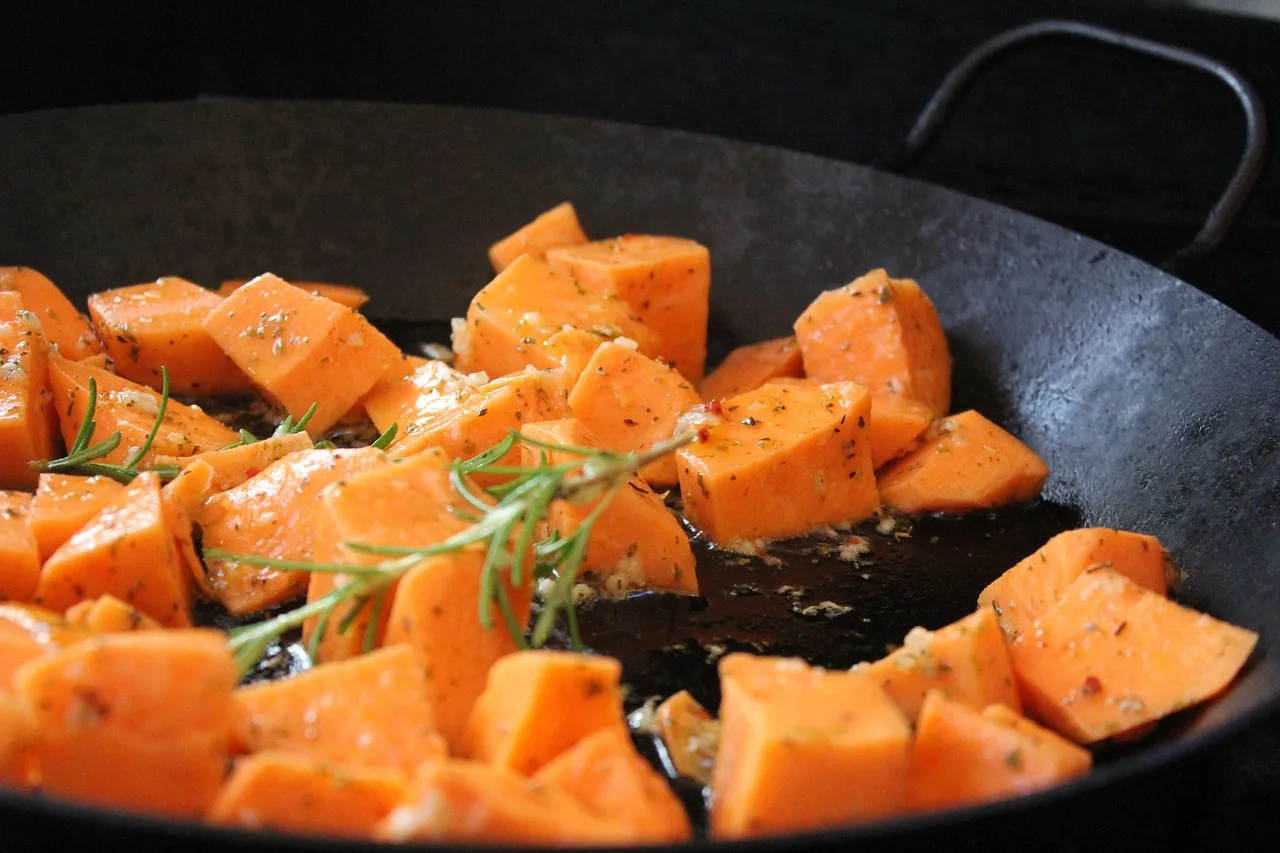
Most sticking comes from residue buildup, overheating, abrasion, or worn coating. Dish soap is safe for modern nonstick cleaning when used gently, so a dirty pan should be cleaned first before anything else. If the pan is damaged, cleaning will not restore the slick surface.
If that didn’t work, try this next
- Wash the pan with dish soap and a soft sponge to remove oil film, sugar, and browned residue.
- Inspect the surface under good light for scratches, peeling, or bare patches.
- Check your heat level: some guidance suggests traditional nonstick should stay below about 450°F, and other guidance cites about 500°F as an overheating limit.
- Try one light oil wipe if the pan is intact and only feels dry.
- Replace the pan if the coating flakes, blisters, or keeps sticking after cleaning.
A common first-timer mistake is using cooking spray as the fix every time eggs stick. That can leave gummy residue that behaves like a bad coating. The better move is a clean pan, a thin oil wipe only when needed, and lower heat.
PTFE vs ceramic care
PTFE and ceramic are different coating types, so they need different care limits. PTFE nonstick should be used at moderate temperatures, with Wirecutter warning against heating above 450°F. Ceramic nonstick often tolerates higher oven heat, but it still wears down over time and should not be pushed hard during normal stovetop use.
PTFE temperature limits and safe use
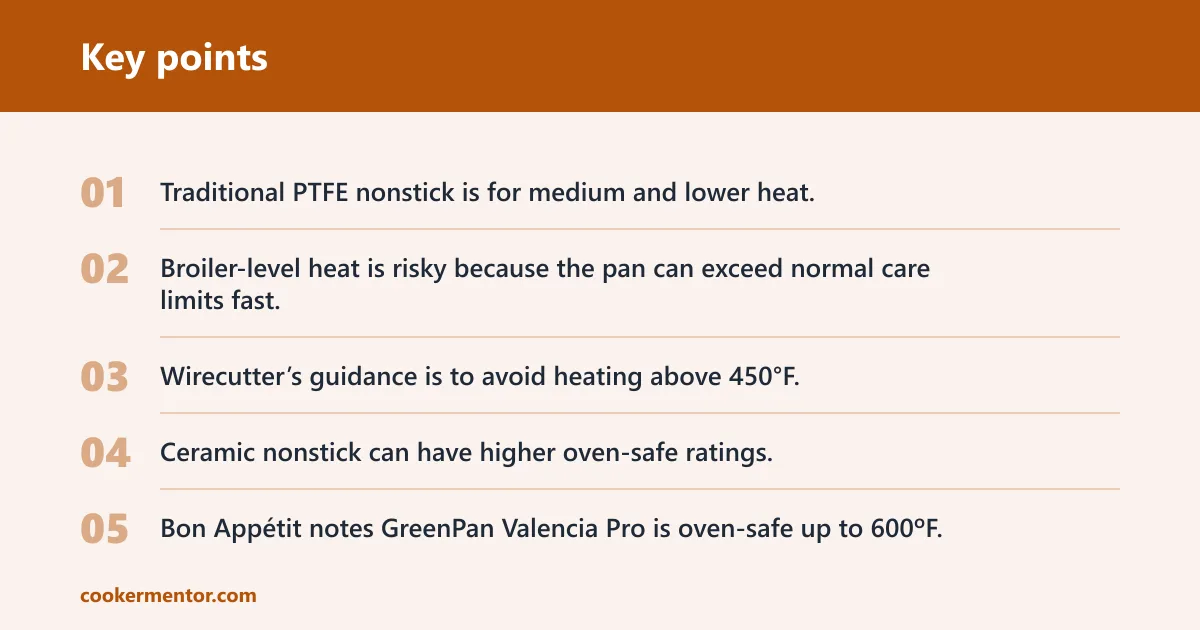
Traditional PTFE nonstick is for medium and lower heat. Broiler-level heat is risky because the pan can exceed normal care limits fast, especially on a burner that runs hot. Wirecutter’s guidance is to avoid heating above 450°F, with some sources citing 500°F as the upper danger zone.
Ceramic nonstick and higher oven ratings
Ceramic nonstick can have higher oven-safe ratings. Bon Appétit notes GreenPan Valencia Pro is oven-safe up to 600ºF, but that does not mean it should be treated as a pan for high-heat seasoning. Ceramic coatings still wear down after a few years, and metal utensils are a bad idea on them.
Wirecutter says ceramic nonstick pans are not recommended because they cost more and perform worse. That does not mean they are unusable. It does mean you should be realistic: if a ceramic pan loses slickness or starts to scratch, conditioning is limited and replacement may be the better call.
How should you care for nonstick pans?
Care starts with gentle cleaning and realistic heat. Hand-wash with dish soap, use a soft cloth or non-scratch sponge, and dry the pan fully. Avoid steel wool and harsh scrubbers, which can scratch the coating and make sticking worse over time.
Nonstick cookware also has a shorter lifespan than cast iron, carbon steel, or stainless steel. A quality nonstick skillet can last for years with proper care, but it will still wear out eventually. That is normal for this category of cookware.
Common mistakes
- Using steel wool or harsh scrubbers, which can scar the coating.
- Cooking over heat that is too high for PTFE nonstick.
- Using a damaged pan as if it were new.
- Relying on cooking spray as a permanent cure for sticking.
- Skipping replacement when the coating flakes or peels.
Picture a ceramic skillet used on medium-high heat for omelets, then cleaned with a rough pad after every use. The pan may lose its slick surface much faster than expected. A softer sponge and lower heat do more for lifespan than any conditioning routine.
Should you use cooking spray on nonstick pans?
Use it carefully, and not as a default fix. Cooking spray can leave a sticky film that builds up over time, which is one reason a pan may start to feel tacky even though the coating is still intact. If that happens, clean the pan well before doing anything else.
If you want a conditioning step, a neutral high-smoke-point oil is the better choice. Grapeseed, avocado, and vegetable oil all work as light conditioning options because they can be wiped into a very thin layer and then removed almost completely. The goal is a film, not a coating.
How much oil is enough?
For a typical 10-inch skillet, start with about 1 teaspoon. Wipe it across the cooking surface, then buff off nearly all of it with a paper towel. If the pan still looks glossy or greasy, too much oil is left behind.
When should you replace nonstick pans?
Replace the pan when the coating is damaged, flaking, scratched through, blistered, or no longer releases food after proper cleaning. A light oil wipe cannot repair worn coating. It can only help a clean surface that has lost some slickness from residue or dryness.
Induction-compatible tri-ply nonstick pans are a special case. The same source says the Tramontina Tri-Ply Nonstick Fry Pan is the induction pick, and encapsulated-bottom skillets are for induction cooktops. Wirecutter also warns that gas or electric cooktops can overheat the sides of encapsulated-bottom pans, so heat control matters there too.
The same source lists the Tramontina Professional Nonstick Fry Pan as a top pick. That kind of useful pan still has a finite life. Once the surface is damaged, replacement is safer than trying to revive it.
Frequently asked questions
How do you season a non stick pan?
You usually do not. Clean the pan with dish soap, dry it, then wipe on about 1 teaspoon of neutral oil for a standard skillet and buff it almost dry. That is conditioning, not seasoning, and it should be used only when the coating is intact.
How do you season nonstick cookware?
Strictly speaking, you do not season it. Wash with mild soap, dry fully, and use a thin oil film only if the surface is clean but feels dry. If the pan still sticks after that, check for scratches, flaking, or overheating damage.
Can you put nonstick pans in the oven?
Sometimes, if the manufacturer says the pan is oven-safe. Ceramic nonstick may be rated much higher for oven use, with some pans rated up to about 600°F. Oven-safe does not mean broiler-safe, and it does not mean the pan should be used for high-heat care.