Air Fryer Size Chart: Basket Size by Servings and Food Type
Choose air fryer size by single-layer fit. A 2-quart unit usually suits 1 serving, 4 quarts suits 2 servings, and 6 quarts suits 3 to 4 servings, but bulky foods need extra room. If the basket is too small, food piles up, traps steam, and browns poorly. This guide links basket size to servings, single-layer capacity, and common foods.
How basket size affects cooking capacity
Quart capacity is the headline number, but it does not tell the full story. The same quart rating can behave differently in a wide, shallow basket than in a deep, narrow one, and the outside size can still be awkward on a counter.
| Quarts | Typical serving range | Best use | Main caution |
|---|---|---|---|
| Under 3 | 1 person | Small batches, reheating, toast for one | Very little room for single-layer cooking |
| 3 to 4 | 2 to 4 people | Small portions of fries, wings, vegetables | Food shape matters a lot |
| 4 to 6 | 2 to 4 people, often 4 with side dishes | Everyday family use | Some models still crowd thick foods |
| 6 to 8 | 4 to 6 people | Larger batches, bigger fillets, mixed meals | Counter footprint grows quickly |
| 8 and up | 6+ people | Large families, batch cooking | Less convenient for small kitchens |
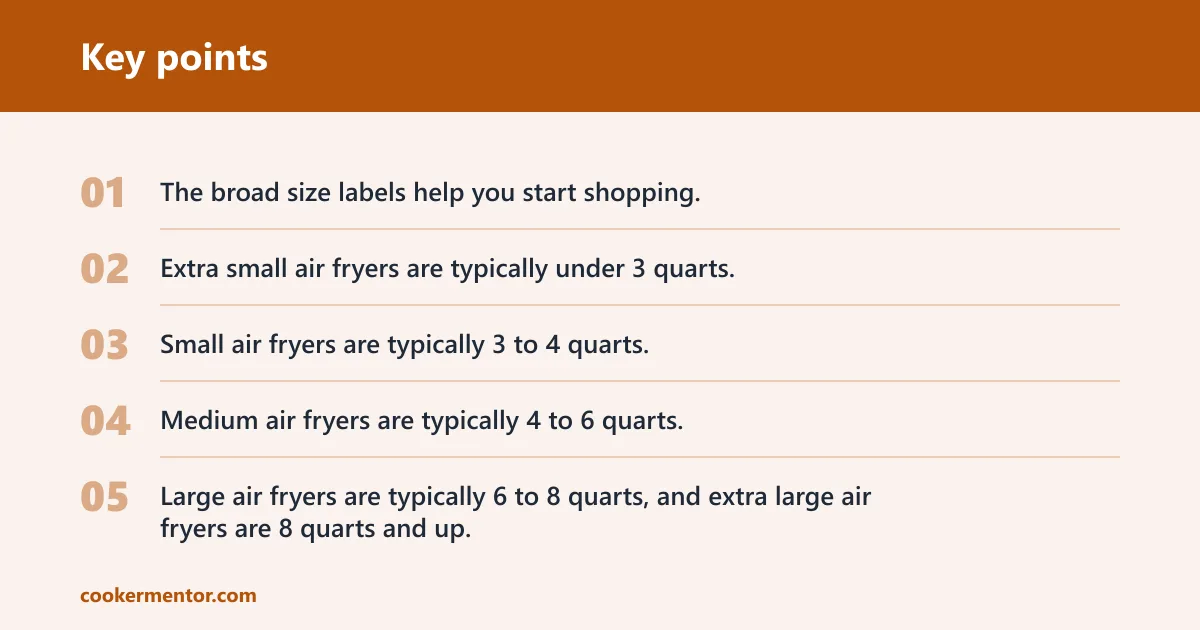
The broad size labels help you start shopping. Extra small air fryers are typically under 3 quarts. Small air fryers are typically 3 to 4 quarts. Medium air fryers are typically 4 to 6 quarts. Large air fryers are typically 6 to 8 quarts, and extra large air fryers are 8 quarts and up.
Basket fit by food type
The chart below is more useful than a quart label alone because it ties size to what actually fits in one layer. The practical limit is not the basket’s stated volume, it is how much food you can spread out without crowding.
| Food type | Approximate single-layer quantity | When to shake or batch-cook | Shape | Best fit | Poor fit |
|---|---|---|---|---|---|
| Fries | Enough to cover the basket in one loose layer | Shake once or twice during cooking; batch-cook if fries overlap heavily | Wide-shallow | Even crisping when the basket floor is broad | Deep baskets that pile fries too high |
| Chicken wings | About 6 to 10 wings in a 5-quart class basket, depending on size | Turn halfway; batch-cook if wings touch on all sides | Wide-shallow | Skin gets better airflow in a single layer | Narrow baskets that stack wings vertically |
| Salmon fillets | Usually 1 to 2 fillets in a typical home basket | No shake; cook in one layer with space between pieces | Wide-shallow | Even exposure for fillets with similar thickness | Deep baskets where fillets must be angled or overlapped |
| Vegetables | A shallow layer of cut pieces | Toss once or twice; batch-cook if steam builds up | Wide-shallow | Broccoli, Brussels sprouts, zucchini, and peppers brown better | Dense piles that trap moisture |
| Toast | Usually 1 to 2 slices at a time | No shake; toast in one flat layer | Wide-shallow | Open baskets or tray-style surfaces | Deep baskets that waste vertical room |
| Whole chicken | Fits only when the bird stays below the basket’s width and height limits | Do not force it; choose a larger basket or oven-style unit if needed | Deep-narrow or oven-style | Deep baskets with enough vertical clearance | Small baskets that cannot hold the bird flat |
Say your main goal is wings for two adults plus a side of fries. A 4-quart basket may still feel cramped if the wings need a full single layer. A 5.5 to 6-quart model usually leaves more room, which can help browning and reduce batch-cooking.
What does air fryer capacity mean?
Air fryer capacity is the rated quart size on the box. That number helps compare models, but it does not tell you how much food fits in one layer or how wide the basket opening is.
Common quart labels
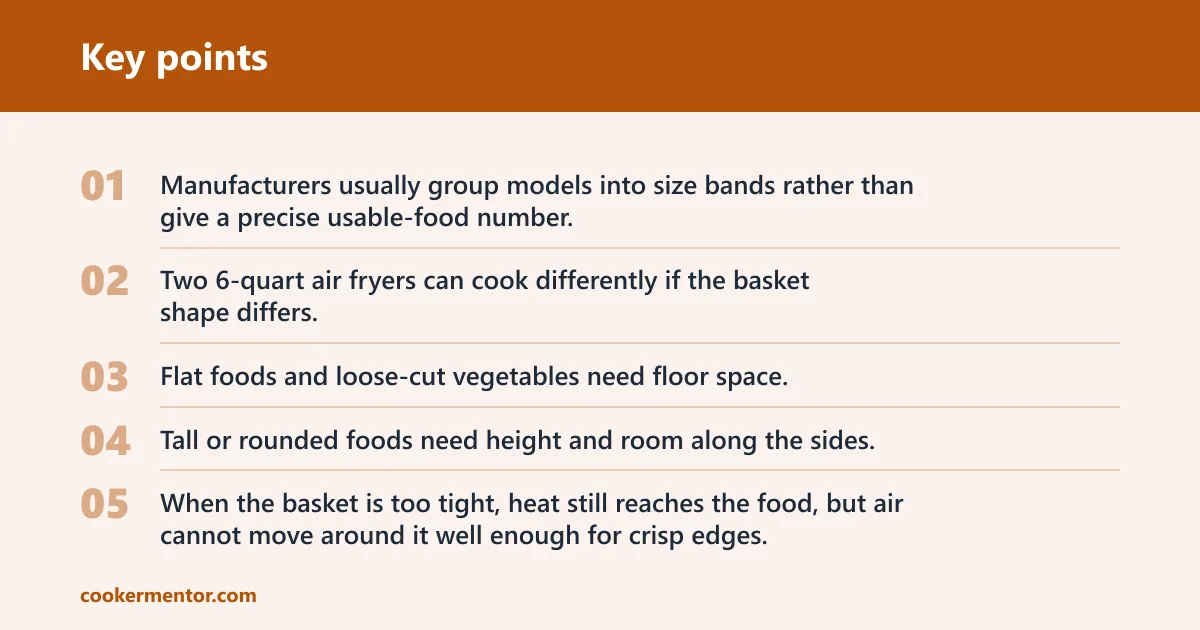
Manufacturers usually group models into size bands rather than give a precise usable-food number. That is why a 6-quart basket can feel roomy for vegetables yet tight for two salmon fillets or a batch of wings.
Why quarts do not equal usable space
Two 6-quart air fryers can cook differently if the basket shape differs. A wide basket can spread fries or wings into a thin layer, while a deep basket may hold the same volume but force the food into a thicker pile. That changes browning as much as capacity.
How to read capacity against food shape
Match the basket to the food you cook most. Flat foods and loose-cut vegetables need floor space. Tall or rounded foods need height and room along the sides. When the basket is too tight, heat still reaches the food, but air cannot move around it well enough for crisp edges.
How many servings can an air fryer hold?
Serving counts are approximate, not exact. The same quart rating can fit different meals, so use serving guidance as a starting point and then check the food shape you cook most often.
1 person
A 1 to 2.5 quart air fryer is shown as serving one person. That works well for a small snack, a single fillet, or a one-person reheating job. It is less useful if you want to cook fries and protein together.
2 to 4 people
A 3 to 5 quart air fryer is shown as serving 2 to 4 people. This is the common range for couples and small families, especially if you cook in one layer and accept that some meals need two batches.
4 to 6 people
A 5.5 to 8 quart air fryer is shown as serving 4 to 6 people. This range fits households that want a better shot at cooking wings, vegetables, or a family side dish without crowding the basket. A 5.5 to 6 quart model is a practical sweet spot for many buyers.
6+ people
A 10 to 15 quart air fryer is shown as serving 6 to 8 people, and a 20 to 32 quart air fryer is shown as serving 8+ people. These larger units make more sense for batch cooking, mixed meals, or air fryer ovens with multiple trays.
How much food fits in one layer?
One-layer cooking is the main rule for crisping. Food needs room for hot air to move around it, and that matters more than the headline quart number when you cook fries, wings, salmon, or vegetables.
Fries and potatoes
Fries fit best when they spread across the basket floor with little overlap. If they sit in a mound, the bottom pieces steam. Potato wedges need even more room because their thicker shape blocks airflow.
Chicken wings
Chicken wings often fit better in a wider basket than a deep one. A common first-timer mistake is filling the basket until the wings touch in a heavy pile. That usually leaves pale spots, so a second batch is better than crowding the first.
Salmon fillets and fish
Salmon fillets need enough width to lie flat. Two fillets can fit in a mid-size basket if they are similar in size and there is a small gap between them. Thick fillets may need a larger basket because the edges brown before the center finishes.
Vegetables and toast
Vegetables cook best in a shallow layer, with a toss partway through to expose new surfaces. Toast needs even more floor space relative to its size because a tall basket does nothing for bread slices that need direct, flat heat.
Whole chicken
Whole chicken is a fit test for both width and height. If the bird touches the sides or lid, or if it cannot sit flat, the basket is too small. An air fryer oven or a larger basket is often the better choice for this use.
Basket shape changes what fits
Shape changes real-world capacity as much as quart rating does. Wide-shallow baskets suit single-layer crisping. Deep-narrow baskets suit taller foods, but they can make fries and wings harder to spread out.
Wide-shallow baskets
Wide-shallow baskets are usually the better pick for fries, wings, vegetables, toast, and thin fillets. The food can sit in one layer with fewer hot spots. That usually means less shaking and better browning across the whole batch.
Deep-narrow baskets
Deep-narrow baskets can work well for taller foods and some whole cuts, but they often reduce the usable floor area. A basket can look large on paper and still underperform for crisping if the food stacks up before it spreads out.
When to batch-cook
- Spread the food first. Put the food into the basket in a single loose layer. If you need to press it down to close the basket, the batch is too large.
- Check overlap. If more than a few pieces touch tightly, cook in two batches. That keeps browning more even and prevents soggy spots.
- Reserve room for turning. Leave enough space to shake, flip, or rotate the food halfway through. Tight baskets make that step harder and reduce crisping.
Suppose a 5-quart basket can hold enough wings by volume but they sit in two layers. The result is usually uneven skin and more steam. Splitting the batch into two rounds often gives better texture than pushing the whole load through at once.
Air fryer size and counter space
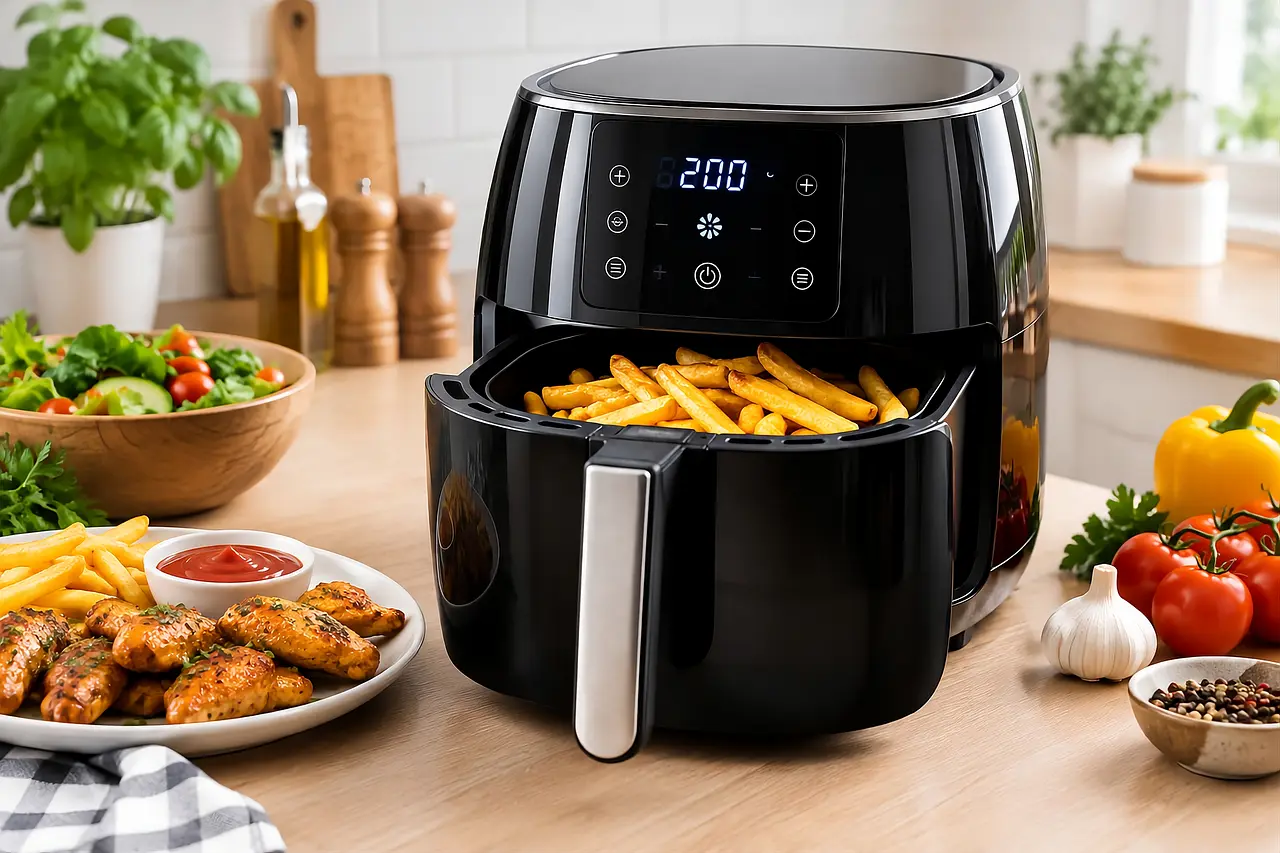
Countertop footprint matters because a larger basket often means a wider, deeper, or taller machine. A model that fits your food can still be awkward if it blocks cabinet doors, sits under low shelves, or leaves no room for the basket to slide out.
Width, depth, and height
Check the full exterior dimensions, not only the basket capacity. Measure the width and depth of the base, plus the height with the basket fully inserted. Then compare that to the counter space where the unit will live, not just where it will be stored.
Cabinet clearance
Leave enough vertical clearance under cabinets or shelves for heat and for the top of the unit. Many larger models need more room than buyers expect, especially if the lid opens upward or the top vents hot air.
Basket pull-out space
Allow space in front of the unit for the basket to pull out without hitting a wall, backsplash, or appliance. That matters for shaking fries, checking doneness, and removing hot food safely.
- Measure the counter width. Record the space where the unit will sit, then leave extra room on both sides so the body does not crowd other appliances.
- Measure the depth. Check from the wall to the front edge of the counter, and include room for the basket to extend when open.
- Measure the height. Compare the unit’s total height with the space under cabinets or shelves, then leave room above for airflow.
- Check pull-out clearance. Pull the basket fully open in your mind, or on paper, and make sure the front edge will not hit nearby items.
- Plan for ventilation. Leave space around the sides and back so the machine can vent heat without pressing tightly against a wall.
Basket, dual-basket, and oven-style models
Model type changes how you should think about size. Basket air fryers prioritize a single cooking chamber. Dual-basket models split that space. Air fryer ovens trade basket width for trays and vertical room.
Basket air fryers
Basket air fryers are the simplest choice for most households. They are usually the easiest for single-layer fries, wings, and vegetables. If your meals are small and mostly one food at a time, a basket model is often the most practical.
Dual-basket air fryers
Dual basket air fryers are usually split capacity. That helps when you want two foods at different temperatures or when you want separate batches without mixing flavors. The tradeoff is a wider footprint, so they need more counter space than a single basket of the same total quart rating.
Air fryer ovens
Air fryer ovens are usually listed by interior volume or tray count. They work well for multi-rack cooking and foods that need vertical clearance, such as toast, whole chicken, or layered vegetables. They are often better for bigger batches, but they take up more space and can be slower to preheat.
Frequently asked questions
What size air fryer do I need for 2 people?
A 3 to 5 quart air fryer is the practical range for 2 people. If you mainly cook fries, wings, or small fillets, 4 quarts is often enough. If you want fewer batches and more room for bigger foods, a 5.5 to 6 quart model gives more breathing room.
How many servings does a 5-quart air fryer hold?
A 5-quart air fryer usually fits 2 to 4 people in practical use. The exact result depends on the food. It works well for side dishes and smaller mains, but bulky items like wings or salmon fillets may still need spacing that cuts the usable portion count.
What size air fryer fits a whole chicken?
Whole chicken usually needs a larger basket or an air fryer oven. A small or mid-size basket can be too short or too narrow, even if the quart number looks acceptable. Check both width and height, because the bird must sit flat without touching the basket walls or top.
How many chicken wings fit in an air fryer basket?
A common 5-quart class basket holds about 6 to 10 wings in a single layer, depending on wing size. If the wings overlap or pile up, cook them in batches. That usually gives better skin and more even browning than forcing the whole load into one round.
What air fryer size is best for a family of 4?
A 5.5 to 8 quart air fryer is the most practical range for a family of 4. If you cook mostly sides and small mains, the lower end can work well. If you want room for wings, salmon, or mixed meals, move toward 6 quarts or larger.
How do I match air fryer size to the food I cook most?
Start with the food, not the quart label. Choose a wide-shallow basket for fries, wings, vegetables, and toast. Choose a deeper basket or oven-style unit if you cook taller foods or want layered trays. If your meals need one clean layer, prioritize floor area over headline capacity.
What is the difference between basket capacity and usable cooking space?
Basket capacity is the rated quart size. Usable cooking space is the room that actually holds food in one layer without crowding. Two air fryers with the same quart rating can cook differently because basket shape, floor area, and vertical room change how the food sits and browns.
How much counter space does a larger air fryer need?
A larger air fryer needs more than a quick glance at the box suggests. Measure width, depth, height, cabinet clearance, and basket pull-out space before buying. Bigger units often need more room for airflow and for safe access, so the footprint can matter as much as the basket size.