Pressure Cooker vs Slow Cooker: Which Uses Less Electricity?
For most braises, beans, and stews, a pressure cooker uses less electricity because it finishes faster, and the shorter run time usually outweighs its higher wattage. A slow cooker can come out ahead only on very long cooks, or if you leave it on keep-warm for hours. Use this guide to compare wattage, cook time, and keep-warm use, then choose the cheaper appliance for each dish.
| Factor | Pressure cooker | Slow cooker | Winner |
|---|---|---|---|
| Typical electricity use per meal | Short, high-power cook; usually lower total kWh for braises, beans, and broth | Lower power draw, but many hours of runtime can push total kWh higher | Pressure cooker |
| Keep-warm impact | Often shorter or easier to skip once cooking ends | Can add meaningful extra draw after cooking if left on for hours | Pressure cooker |
| Best fit for long unattended cooking | Good for fast cook cycles, less suited to all-day timing | Strong fit for 4 to 8 hour cooks and low-intervention meals | Slow cooker |
| Cost sensitivity to recipe length | Less exposed because cook time is shorter | More exposed because every extra hour adds to total kWh | Pressure cooker |
Electricity cost comparison table
For this cost table, use a simple working assumption: a typical electric pressure cooker draws about 1,000 watts while cooking, and a typical slow cooker draws about 200 watts. Exact wattage varies by model, so treat these as planning figures, not fixed specs.
| Scenario | Pressure cooker kWh | Slow cooker kWh | Estimated cost at 30p/kWh | Cheaper option |
|---|---|---|---|---|
| Stew | 0.58 kWh | 1.30 kWh | Pressure cooker: 17p; slow cooker: 39p | Pressure cooker |
| Beans | 0.75 kWh | 1.60 kWh | Pressure cooker: 23p; slow cooker: 48p | Pressure cooker |
| Broth | 1.50 kWh | 2.00 kWh | Pressure cooker: 45p; slow cooker: 60p | Pressure cooker |
Those estimates assume the pressure cooker includes a brief heat-up and pressure phase, while the slow cooker runs through the full cooking period and may spend extra time on keep-warm. If you use a higher tariff, multiply both cost figures by the same amount.
Which uses less electricity?
For most stews, beans, and soups, the pressure cooker uses less electricity because it cuts the cooking window from hours to minutes. The slow cooker can still be cheaper on some long recipes, but only when the meal needs extended low heat and the appliance is not left on keep-warm for a long stretch.
When a pressure cooker usually wins
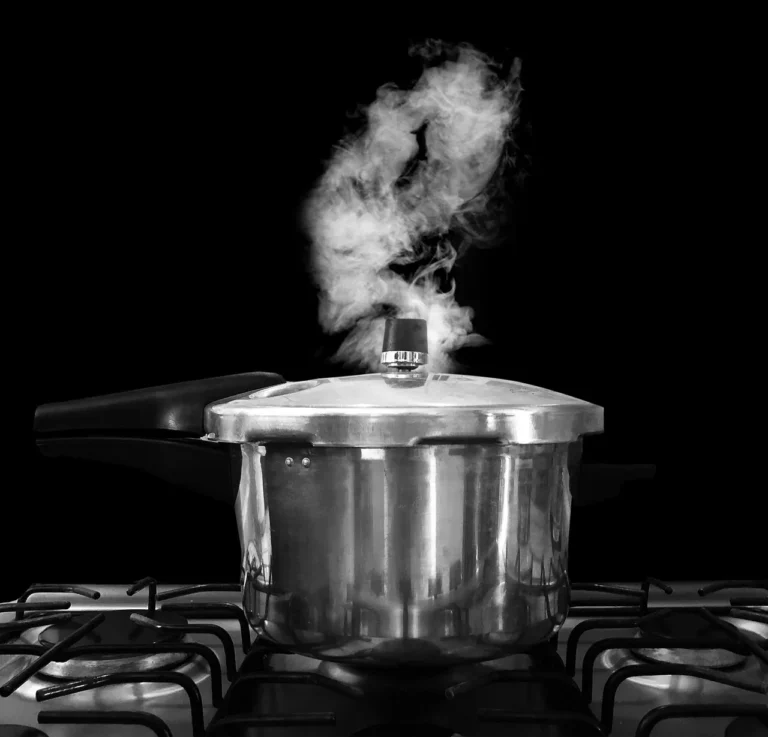
An electric pressure cooker cooks sealed food with steam pressure and reaches high cooking temperatures. That sealed chamber cuts evaporation and shortens the active cook, so total kWh usually stays lower even though the wattage is higher.
A pressure cooker can cook food in around a third of the time it would take on the hob, and that time saving is what drives the electricity saving. If a beef stew takes 25 minutes in a pressure cooker, the same stew can take between 4 to 8 hours in a slow cooker.
When a slow cooker can be cheaper
A slow cooker uses low steady heat in a ceramic or stoneware bowl, usually on low or high settings for long cooks. It is among the kitchen’s most energy-efficient appliances because it heats a small space, but a long runtime still adds up.
If a recipe needs a very long simmer, or if you leave the unit on keep-warm for several hours, the lower wattage can be overtaken by the longer duration.
How much electricity does each appliance use?
Electricity use depends on wattage, cook time, preheat time, heat retention, keep-warm draw, and the tariff you pay. Appliance type matters, but the full time on the plug matters more.
Typical electric pressure cooker wattage and runtime
A typical electric pressure cooker often draws around 1,000 watts, though model ratings vary. The useful part is the short runtime: pressure build, cook phase, pressure release, and any rest period together still often add up to less total energy than a many-hour slow cook.
Be careful with lid lifting and repeated pressure loss. Every time you open the lid, you interrupt the sealed chamber, add time back to the recipe, and raise the total kWh. Altitude also matters: pressure-cooking adjustments vary by recipe and altitude band, so check guidance for your model.
Typical slow cooker wattage and runtime
A slow cooker often draws far less power than a pressure cooker while it is running, but it is used for 4-8 hour cooks. Slow cooker temperatures are usually low enough for gentle simmering rather than high-heat cooking, and the usual result is a long, steady run rather than a quick burst.
Size matters here. An ideal slow cooker size under 3 litres suits 1 to 2 people, a 3 to 4.9 litre slow cooker suits 2 to 4 people, and a 5-litre-and-above slow cooker suits 4 or more people. Slow cookers work best when they are around half to three-quarters full.
How keep-warm changes the total
Keep-warm is the hidden cost driver that many comparisons skip. A slow cooker may use little power during the main cook, then stay connected for another hour or three after the food is done. That extra time can add enough kWh to erase the wattage advantage.
Some electric pressure cookers also include keep-warm and sauté functions, so the same rule applies: what matters is the full plug-in time, not only the headline cook phase.
To estimate the cost, follow these steps.
Check the wattage. Find the appliance rating on the label or manual. Use that number in watts, because the running cost estimate starts there.
Estimate the full runtime. Include preheat, cook time, and any keep-warm period. For a slow cooker, that may mean 6 to 10 hours total. For a pressure cooker, it may mean 30 to 90 minutes total, depending on the recipe.
Convert to kWh. Divide watts by 1,000, then multiply by hours. A 1,000-watt pressure cooker used for 0.75 hours uses 0.75 kWh. A 200-watt slow cooker used for 6 hours uses 1.2 kWh.
Multiply by your tariff. Use your electricity price per kWh to get cost per meal. At 30p/kWh, 0.75 kWh costs 22.5p, while 1.2 kWh costs 36p.
Suppose you cook a beef stew in a 5-litre slow cooker filled halfway. If the food stays on keep-warm for two extra hours, the final bill can shift enough that the slower method is no longer the cheaper one. The same stew in a pressure cooker may finish sooner and avoid that extra draw.
Does cooking time or wattage matter more for electricity cost?
Cooking time usually matters more, because electricity cost is wattage multiplied by hours used. A lower-watt appliance that runs for a long time can cost more than a higher-watt appliance that finishes fast.
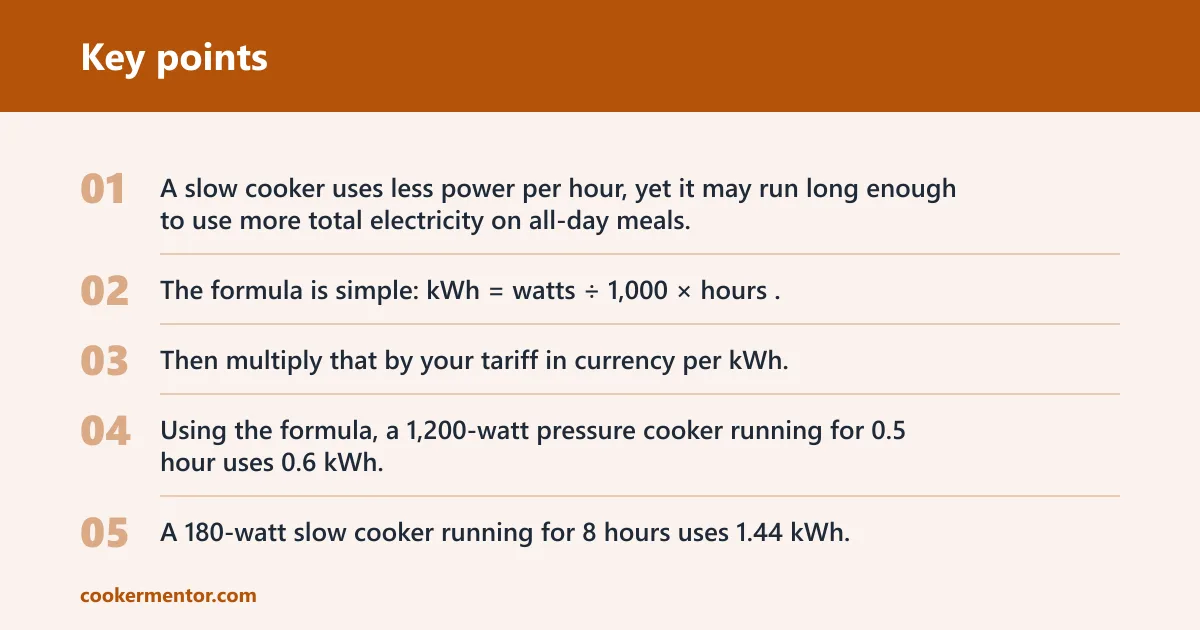
That is the main reason a pressure cooker often wins on total cost. It uses more power at once, but for a much shorter period. A slow cooker uses less power per hour, yet it may run long enough to use more total electricity on all-day meals.
How kWh is calculated
The formula is simple: kWh = watts ÷ 1,000 × hours. Then multiply that by your tariff in currency per kWh. This gives a usable estimate for comparing appliances and recipes.
Using the formula, a 1,200-watt pressure cooker running for 0.5 hour uses 0.6 kWh. A 180-watt slow cooker running for 8 hours uses 1.44 kWh. The slow cooker can still be the better comfort choice for timing, but the pressure cooker is cheaper on electricity in that case.
Why lid lifting and release time matter
Pressure cooking depends on a sealed chamber and controlled steam pressure. If you lift the lid during cooking, you lose heat and pressure, and the appliance has to work again to recover. That raises the total kWh and can cut the cost advantage.
Slow cookers are less sensitive to brief opening, but opening the lid still drops temperature and adds time. The food may need longer to return to a safe simmer, which pushes total consumption up.
What about food type and fill level?
Food type changes the answer because some dishes benefit from pressure, while others need extended low heat to break down slowly. Fill level matters too, especially in slow cookers, where the bowl should usually be around half to three-quarters full for best performance.
Stews, soups, and curries
These are the easiest comparison. Both appliances work well, but a pressure cooker usually wins on cost because it tenderizes quickly and keeps evaporation low. That matters for soups and curries where the liquid does not need all-day reduction.
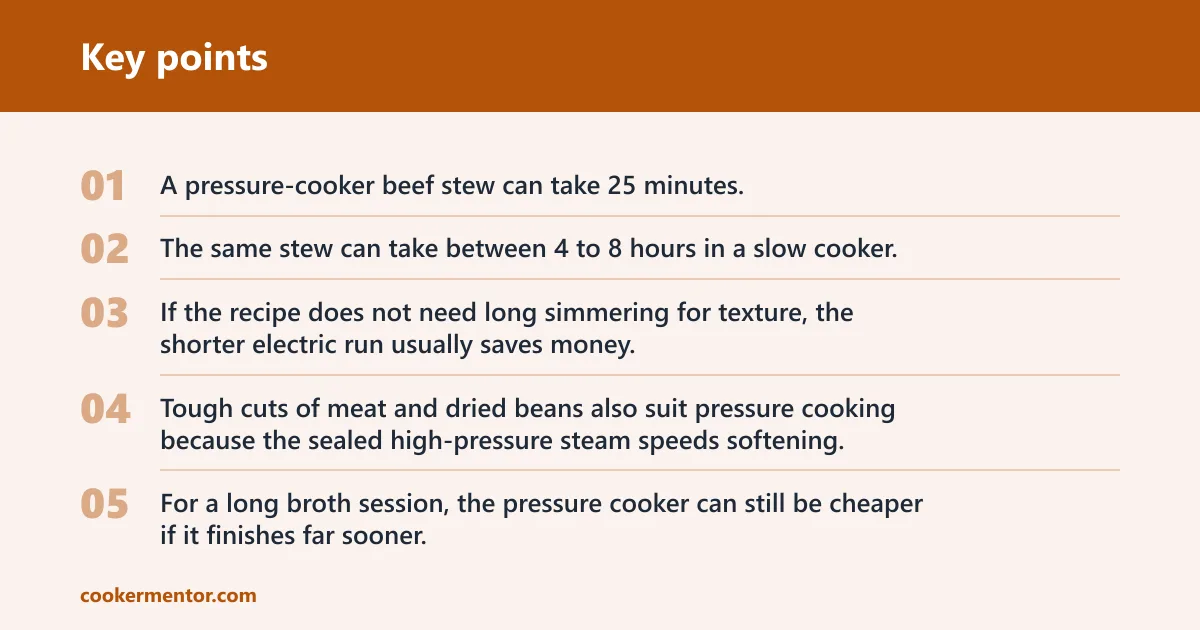
A pressure-cooker beef stew can take 25 minutes. The same stew can take between 4 to 8 hours in a slow cooker. If the recipe does not need long simmering for texture, the shorter electric run usually saves money.
Pulled meats, beans, and bone broth
Tough cuts of meat and dried beans also suit pressure cooking because the sealed high-pressure steam speeds softening. Bone broth is the more mixed case: some cooks prefer the longer slow cooker schedule, while others prefer the faster pressure cooker route for lower electricity use.
For a long broth session, the pressure cooker can still be cheaper if it finishes far sooner. If the slow cooker sits on low for many hours after the main cook, the extra time can outweigh its lower hourly draw.
Why size and fill level change results
Underfilled slow cookers waste more heat at the air gap above the food, while overfilled ones can cook unevenly and take longer. That is why the half to three-quarters full guideline matters. It helps the appliance use its heat on the food rather than the empty space.
Pressure cookers also need the right fill level for safe operation. They should not be packed too full, especially with foods that foam or expand. Safety features such as a pressure release valve, lid sealing, and built-in pressure control reduce risk, but misuse can still create burn hazards.
Choose Pressure cooker if… / Choose slow cooker if…
Pick the pressure cooker when your goal is the lowest electricity use for stews, beans, curries, pulled meat, or broth and you want the meal done in a short block of time. Pick the slow cooker when you need an all-day unattended cook, prefer a low steady heat cycle, or want the food ready after many hours without active attention.
Choose pressure cooker if…
- You want the cheapest run for most braises, beans, and stews.
- You need dinner ready in under an hour, including pressure build and release.
- You want to avoid long keep-warm time.
- Your recipe does not need hours of gentle evaporation.
Choose slow cooker if…
- You need a 4 to 8 hour unattended cook.
- You are making a large batch that fits the half to three-quarters full guideline.
- You value low hands-on attention over the lowest possible kWh.
- You can turn it off when the food is done instead of leaving it on keep-warm.
Frequently asked questions
Which uses less electricity, a pressure cooker or a slow cooker?
For most stews, beans, and soups, a pressure cooker uses less electricity because it finishes much faster. A slow cooker can be cheaper on some long recipes, but its longer runtime and any keep-warm period often raise the total kWh.
Is a pressure cooker cheaper to run than a slow cooker?
Usually, yes, for the same meal. The higher wattage is offset by shorter cooking time. If the recipe is very long or the slow cooker stays on keep-warm for hours, the cost gap can narrow or reverse.
How much electricity does a slow cooker use in a day?
A slow cooker used all day can draw a surprisingly large total even though the hourly rate is low. The answer depends on wattage and runtime, but a 200-watt unit running for 8 hours uses 1.6 kWh before keep-warm is added.
How much electricity does a pressure cooker use per meal?
It depends on the meal, but many pressure-cooker recipes land below the slow cooker’s total because the runtime is short. A stew that takes about 25 minutes can use well under 1 kWh when you include the full cook cycle.
Are electric pressure cookers more efficient than slow cookers?
For many meals, yes. Electric pressure cookers are often more efficient because they cook food in a sealed chamber with steam pressure, which shortens the time needed. Slow cookers remain efficient, but the long runtime can raise total consumption.
How much does it cost to run an Instant Pot versus a Crock-Pot?
Brand labels do not change the basic math. Use the appliance wattage, cook time, and your tariff. A typical electric pressure cooker like an Instant Pot-style unit will often cost less per meal than a typical Crock-Pot-style slow cooker for the same stew or beans, especially at higher tariffs.
Which appliance is more energy efficient for stews and soups?
For most stews and soups, the pressure cooker is the more energy efficient choice because it cuts the cooking time so sharply. A slow cooker still makes sense when you want a long unattended cook and can keep the bowl properly filled.