Why Do Stainless Steel Pans Get Cloudy, and How Do You Fix It?
If cloudy stainless steel wipes off with vinegar or a baking-soda paste, it is usually mineral scale; rainbow heat tint needs a mild abrasive cleaner, and a permanently dull, frosted look is etching. Ignore the cause and you can waste time, scratch the pan, or leave the finish worse. This guide shows how to identify each type of cloudiness and use the least aggressive fix that fits.
Why stainless steel looks cloudy
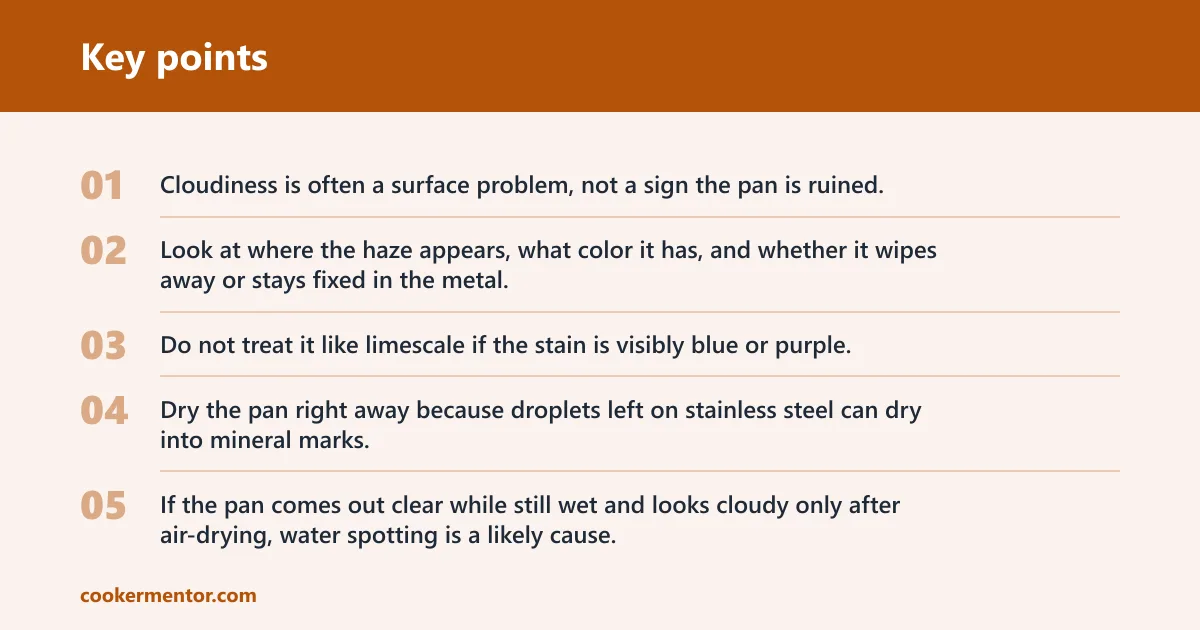
Cloudiness is often a surface problem, not a sign the pan is ruined. Look at where the haze appears, what color it has, and whether it wipes away or stays fixed in the metal.
White film from minerals
Hard water mineral deposits can contain calcium, and when water evaporates or boils, that calcium can stay behind as calcium carbonate, also called limescale. It often looks like a white chalky film, pale streaks, or cloudy spots after boiling water or a dishwasher cycle.
That residue can cling to cookware without harming the pan. It dulls the finish, but it usually sits on top of the steel instead of changing the steel itself.
Heat tint and rainbow discoloration
Blue, purple, or gold discoloration is usually heat tint, which is a thin layer of oxide that forms when steel is heated hard enough. It often appears on the bottom or lower sides of the pan where heat is strongest. This is different from white mineral film.
Light heat tint can often be reduced with a mild vinegar soak of 5–10 minutes, or with an oxalic-acid cleanser when the color is more stubborn. Do not treat it like limescale if the stain is visibly blue or purple.
Dishwasher haze and water spots
Dishwasher detergent and heat can leave a cloudy haze or spots, especially if the water is hard, the rinse aid is missing, or the pan dries slowly. This often shows up as streaks, a dull film, or chalky spotting after a full cycle.
Dry the pan right away because droplets left on stainless steel can dry into mineral marks. If the pan comes out clear while still wet and looks cloudy only after air-drying, water spotting is a likely cause.
Cloudy pan troubleshooting matrix
Use the visible symptom first, then match the fix to the most likely cause. That keeps you from scrubbing too hard when a mild acid would work, or from using vinegar on a stain that needs a different cleaner.
| Visible symptom | Likely cause | Fastest safe fix | Prevention step |
|---|---|---|---|
| White chalky film after boiling water | Hard water mineral deposits, often calcium carbonate | Wipe with diluted white vinegar, then rinse and dry | Dry right away and avoid leaving boil water to evaporate in the pan |
| Cloudy haze after dishwasher use | Detergent residue, heat, or mineral spotting | Wash by hand with soap, then dry immediately | Use rinse aid and finish with prompt drying |
| Blue, purple, or gold rainbow tint | Heat tint, a thin oxide layer | Use a mild vinegar soak or an oxalic-acid stainless cleaner | Use moderate heat and avoid prolonged overheating |
| Streaky water spots on the outside or bottom | Hard water droplets dried on the surface | Wash, rinse, and towel-dry the pan immediately | Use rinse aid in the dishwasher and dry by hand after washing |
| Cloudiness only on the bottom after stovetop use | Heat tint or burned-on residue | Try vinegar for light tint; use a stainless cleaner if needed | Keep heat moderate and avoid long empty preheats |
| Cloudy interior after boiling pasta or potatoes | Mineral deposits from hard water | Soak briefly in diluted vinegar, then rinse | Empty the pot soon after cooking and dry it |
| Film returns quickly after wiping | Repeated hard-water spotting or dishwasher residue | Use vinegar first, then adjust washing and drying habits | Add rinse aid and avoid air-drying in spots |
| Permanently dull, rough, or frosted finish | Detergent etching or pitting | Stop scrubbing; the surface may be damaged | Use gentler detergent and avoid harsh cleaners |
How do you remove cloudy spots?
Use the least aggressive method that matches the stain. For white mineral film, diluted white vinegar is usually enough. For rainbow tint or residue that does not budge, an oxalic-acid cleaner such as Bar Keepers Friend can help when the stain fits that type of mark.
Vinegar for mineral deposits
White vinegar is a mild acid, and it can dissolve mineral deposits without heavy scrubbing. Taste of Home recommends three parts white vinegar to one part water, then bringing the mixture to a boil for baked-on scale. For lighter film, a short soak can be enough.
-
Mix the cleaning solution.
Combine three parts white vinegar to one part water in the pan for white film, or use a milder diluted soak for light spots. The goal is to put acid directly on the calcium carbonate without scratching the finish. -
Warm the mixture gently.
Bring the vinegar mixture to a boil if the deposit is baked on, then turn off the heat. Heat helps loosen calcium carbonate that has clung after boiling water or repeated dishwasher cycles. -
Let it sit briefly.
For light tint or film, a 5–10 minute soak is often enough. Longer contact is not always better, especially if the issue is not mineral scale. -
Wipe with a non-abrasive sponge.
Use a soft sponge with dish soap if needed, then rinse well. A non-abrasive sponge removes loosened residue without the scratching that steel wool can cause. -
Dry immediately.
Finish with a clean towel. Drying keeps dissolved minerals from drying back onto the surface as new spots.
Oxalic-acid cleaner for stubborn film
Bar Keepers Friend is commonly recommended as an oxalic-acid stainless cleanser for marks that vinegar does not remove. It is a better fit for stubborn residue or some heat tint than for rough, etched metal. Use only on stains that match that type of buildup.
-
Confirm the stain type.
Use this cleaner for stubborn haze, mineral residue, or rainbow tint that does not respond to vinegar. If the surface looks pitted, frosted, or permanently rough, stop and reassess. -
Apply with a damp sponge.
Make a light paste or use the cleanser as directed on the label, then work it in with a non-abrasive sponge. This limits scratching while the acid loosens the stain. -
Rinse thoroughly.
Remove all residue, then dry with a clean towel. Leftover cleanser can leave a new film if it dries on the pan.
When to stop scrubbing
If the mark does not move after a gentle vinegar treatment and a soft sponge, harder scrubbing is usually the wrong next step. Pitting and detergent etching are different from removable cloudiness. They involve actual surface change, so more force will not restore the finish.
Suppose a 10-inch skillet has a cloudy bottom after high heat and the blue-purple tint stays after vinegar. That points away from mineral film and toward heat tint, so a stainless cleaner is more appropriate than repeated vinegar soaks. Now picture a pot with a matte, rough interior after many dishwasher cycles; that pattern is more consistent with etching than with removable spots.
Will vinegar remove white film from stainless steel cookware?
White vinegar can often remove white film when the problem is mineral scale. It works best on hard-water deposits, calcium carbonate, and light heat tint. It will not repair etched steel or remove damage that has changed the surface itself.
Diluted soak for light deposits
For a light white haze, dilute the vinegar with water and let the stained area sit briefly. The acid loosens calcium deposits so they can be wiped away with a non-abrasive sponge. This is usually enough when the film is recent and not baked on.
Brief boil for baked-on scale
If the residue formed after boiling water, a brief boil of the vinegar-and-water mixture can help. The combination of heat and mild acid breaks down calcium carbonate, which can cling after evaporation. Rinse well afterward so the pan does not hold a vinegar smell.
What vinegar will not fix
Vinegar is not the right answer for pitting, etching, or heavy heat tint that has turned the surface dull and rough. It also will not undo scratches from abrasive pads. If the pan still looks cloudy after a vinegar soak and the film feels fixed in place, switch to diagnosis instead of more scrubbing.
What causes dishwasher cloudiness?
Dishwasher cloudiness commonly comes from detergent residue, hard water, heat, or incomplete drying. The pan may come out clear and turn hazy as it dries, which points to water spots rather than permanent damage. Missing rinse aid often makes the problem worse.
Detergent residue and hard water
Dishwasher detergent and heat can leave a cloudy haze on stainless steel cookware, especially in areas with hard water. Hard water contains calcium, and that mineral load can dry onto the pan during the cycle. The result can look like a film, streaking, or a dull film on the exterior.
Cleanipedia recommends using hot water if the pan is still hot, and it warns that too-cool water on a hot pan can warp it. After washing, dry immediately to avoid water spots. That matters for both appearance and long-term care.
Why rinse aid helps
Rinse aid creates a thin layer that helps water sheet off cookware instead of drying in droplets. That means fewer spots, less chalky residue, and less cloudy haze after the cycle. It is especially useful if your water leaves visible mineral marks on glass or steel.
Drying the pan right away
Even a well-rinsed pan can spot if it air-dries with hard water on the surface. A clean towel removes the last droplets before they can dry into marks. If the cloudiness only appears after the pan sits on the rack, drying is a big part of the fix.
-
Check the rinse aid reservoir.
Make sure the dishwasher has rinse aid filled to the recommended level. This helps water leave the surface in sheets instead of beads. -
Remove the pan promptly.
Open the door when the cycle ends and take the pan out before droplets dry. This reduces spotting from hard water and detergent residue. -
Towel-dry immediately.
Use a clean towel as soon as the pan is safe to handle. Drying is one of the simplest ways to prevent new cloudiness.
Can cloudy stainless steel be harmful?
Most cloudy residue is cosmetic, not harmful. White mineral film, light water spots, and mild heat tint do not usually mean the pan is unsafe. The concern starts when the surface looks permanently rough, pitted, or etched, because that points to actual damage.
Cosmetic film versus damaged surface
A removable film sits on top of the steel. Damaged steel looks frosted, rough, or permanently dulled, and it does not clean up with vinegar or a soft sponge. If the appearance changes only in the cloudy area and the texture feels altered, the issue may be more than residue.
Signs of pitting or etching
Pitting often looks like tiny holes or rough spots that catch light unevenly. Etching can look like a uniform frosted patch, and it is often associated with repeated dishwasher exposure or harsh detergent. Neither one improves with harder scrubbing, and aggressive pads can make the surface worse.
A common first-timer mistake is to keep scrubbing a pan that already has etched stainless. If the cloudy area stays fixed after vinegar, a non-abrasive sponge, and rinsing, the issue is likely damage rather than buildup.
When replacement makes more sense
Replacement is worth considering when the pan is badly pitted, the surface has lost its even finish, or the damage keeps spreading after normal cleaning. If only the appearance changed and the cooking surface is still smooth, the pan can usually stay in service.
How do you keep pans from clouding again?
Prevention comes down to gentler washing, prompt drying, and reducing mineral deposits before they dry on the pan. A non-abrasive sponge, immediate towel-drying, and rinse aid in the dishwasher are commonly recommended to help prevent recurring cloudiness. Very hard water may need extra attention.
Wash with a non-abrasive sponge
Use a non-abrasive sponge with dish soap for routine cleaning. It removes residue without scratching the finish, which matters because scratches catch minerals and make future spotting easier to see. Steel wool and stiff metal scourers should stay off stainless steel.
Dry immediately after rinsing
Drying right after rinsing is one of the most reliable ways to prevent spots. Water left on the surface can leave calcium behind when it evaporates, especially in hard-water areas. A clean towel is enough for most pans.
Reduce spots from hard water
If cloudiness keeps coming back, the water supply may be the issue rather than the pan. Rinse aid, quicker drying, and occasional vinegar cleaning can help manage the mineral load. If the pan is boiled often, empty it soon after use so calcium carbonate does not bake on.
-
Rinse before residue dries.
Wash the pan soon after cooking so food and minerals do not harden on the surface. This makes the next cleaning easier and lowers the chance of clouding. -
Use gentle tools only.
Stick with soap and a non-abrasive sponge for routine cleaning. Reserve vinegar or oxalic-acid cleanser for the right type of stain. -
Control dishwasher spotting.
Add rinse aid, avoid overcrowding, and dry the pan right away after the cycle. These steps reduce the water marks that often look like cloudy haze.
Frequently asked questions
Why does my stainless steel pan look cloudy?
Cloudiness usually comes from hard water mineral deposits, dishwasher residue, or heat tint. White film is often calcium-based scale, while blue or purple color points to heat tint. If the surface feels permanently dull or rough, the issue may be etching rather than removable residue.
Is the cloudy film on stainless steel cookware harmful?
Usually not. Most cloudy residue is cosmetic and does not make the pan unsafe. The main exception is surface damage such as pitting or etching, which changes the finish but still does not mean the pan is dangerous in ordinary home use.
How do you remove cloudy spots from stainless steel pans?
Start with diluted white vinegar and a non-abrasive sponge if the stain looks white or chalky. If that fails and the mark is rainbow or stubborn haze, use an oxalic-acid cleaner such as Bar Keepers Friend. Stop if the surface appears etched or rough.
What causes cloudy stainless steel after using the dishwasher?
Dishwasher detergent, heat, hard water, and missing rinse aid can all leave haze or water spots. If the pan looks cloudy only after it air-dries, the problem is likely mineral spotting. Prompt drying and rinse aid usually help prevent it from returning.
Can Bar Keepers Friend remove cloudy stainless steel?
It can help when the cloudiness is stubborn mineral residue or heat tint that vinegar did not remove. It is an oxalic-acid stainless cleanser, so use it on the right type of stain and apply it with a non-abrasive sponge. Do not use it as a fix for pitting or etching.